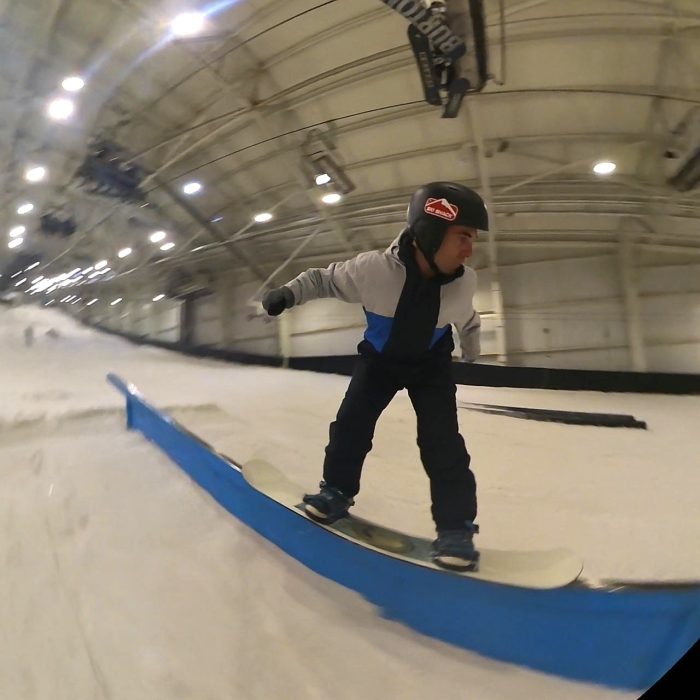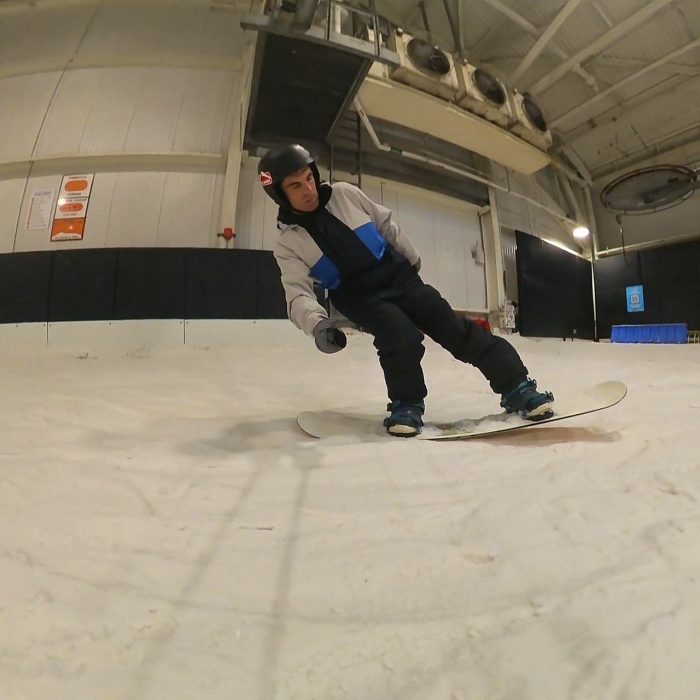



The Nidecker Tape Deck is excellent for jumping, easy and stable to carve with, and decent for jibbing and buttering.
It’s a traditional camber, true twin-shaped freestyle deck, with a generous amount of camber between your feet, but the tips of the board were made specifically to make it more forgiving and easier to ride.
Nidecker Tape Deck 2027 at a Glance
This is an affiliate link pointing to Nidecker’s website. It won’t cost you anything additional to use, and it supports this website. When you use it, Nidecker share a small commission from your purchase, and that goes towards more gear to review as well as the fees for hosting the site and its mobile app.
|
Board Reviewed |
Nidecker Tape Deck 2027 |
Price | $529.95 |
Shape and Profile | True twin, traditional camber with a steep kicked nose and tail, 0mm setback |
|
Flex |
6.5 out of 10 |
|
Best For |
Park riders who want a twin that jumps, carves, and holds its own outside the park |
|
Size I Rode | 153cm (for reference, I am 142lbs, 5′ 6″ tall with a US men’s size 9 boot) |
Summary: My Overall Impression of the Nidecker Tape Deck
Overall, the Nidecker Tape Deck was an easy and intuitive board to ride. It isn’t overly loaded up with tech you’ll never use, but there are two noteworthy features of the Tape Deck’s tech.
1) Carbon in the nose and tail for extra pop off jumps
2) A light core with extra dampening added to make the ride feel higher end than other boards in its price category.
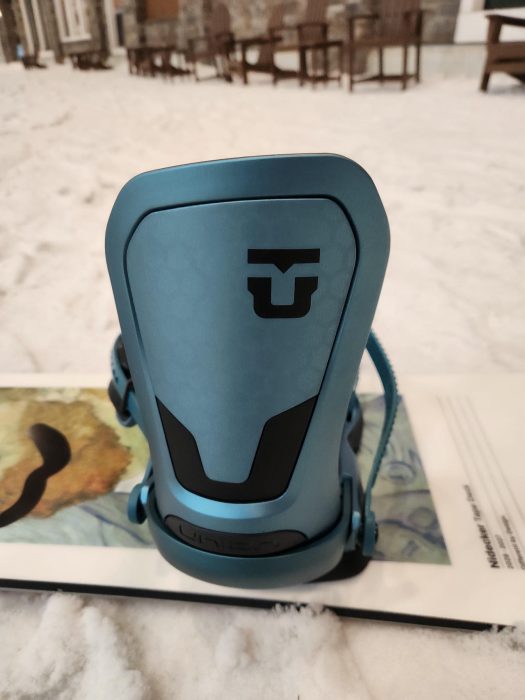
I rode the Tape Deck for two sessions at Big Snow in East Rutherford, NJ, on the 153cm with the new Union NEO bindings and ThirtyTwo STW Boa boots. Big Snow is an indoor slope, so that’s consistent manmade snow with no weather surprises added in the mix. The main thing to know is that the snow there is often dirty and slow, and the base of the Tape Deck held its glide perfectly with just a normal wax job.
As you read, please keep in mind this is a review of the board’s park and groomer performance as I’ve only ridden it indoors so far. I’ll update this as I get more time on it. One important thing to flag up front is that I actually broke an edge jibbing during my review of this board, and I get into exactly what happened and what Nidecker had to say about it in the “I Broke an Edge Jibbing at Big Snow” below.
Review Rating of the Nidecker Tape Deck
This rating scale prioritizes carving and versatility, along with park performance.
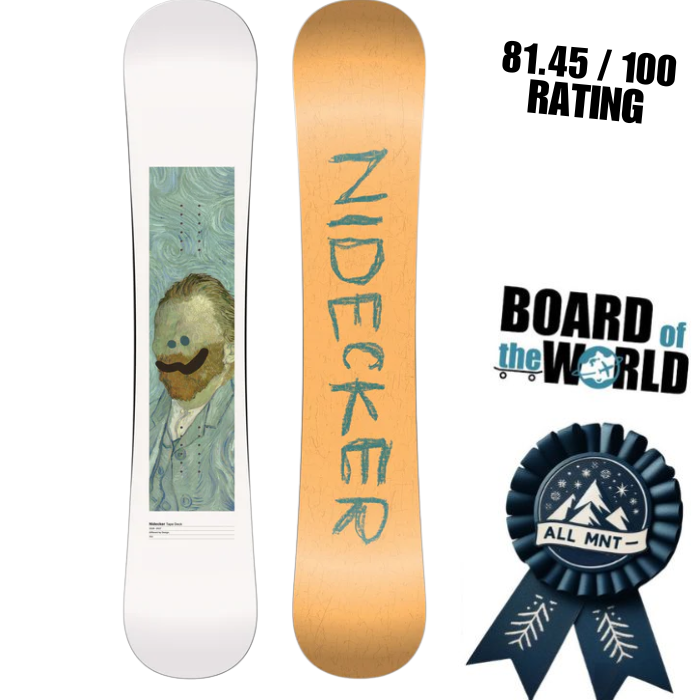
The Tape Deck earned a 82.3 out of a possible 100 in our All-Mountain / Freestyle boards rating scale. Here are the stats from the review.
How Does the Nidecker Tape Deck Perform Across Riding Styles?
Carving
This is where the Tape Deck really shined for me. The carving experience felt smooth and stable, which is what you want out of a slightly stiffer than medium traditional camber twin.

What stood out to me was its easy turn initiation and how locked in it felt once I engaged a turn. While it’s got 90s inspiration, this board is easier to turn than the camber decks I grew up riding, and I’d give the exaggerated nose and tail angles credit for that.
The rest comes down to the sidecut. It’s got a continuous radial sidecut that measures out to be 7.4m on the 153cm size I rode, so the turn shape stays the same from the second you set your edge to the second you come off it. There’s no point in the middle of your turn where it felt like it hooks or changes on you. It stays locked in and finishes through its arc before it allows you to make your next turn.
Speed and the Base
This has a sintruded base that’s a blend of extruded and sintered material. For me, it held its speed really well, and there is barely a scratch on it after two sessions of jibbing.
At Big Snow, the snow is usually very slow, so it can be difficult to keep a consistent glide through the bottom of the course. I didn’t have that issue with this deck. With a quick wax job before I rode it, I was able to get from feature to feature to the bottom with no issues.
It wasn’t the fastest base I’ve ever been on, but it definitely wasn’t the slowest. Speed-wise, it felt like a sintered base. You get the benefits of not needing to wax it as often.
Jumping
The Tape Deck is an excellent deck for jumping and hitting side hits. The pop has that little extra snap of power to boost you, and I found it easy and predictable to time. The combination of camber with carbon in its tips adds a noticeable kick to it. I’d say it offers around 5% more pop over the average camber freestyle board.

The shock absorption built into this deck helps to make your landings feel a little easier too.
One thing to keep in mind is that I rode this deck on a short indoor course that you lap over and over, so hitting the same jump twenty times in a session gives you a strong feel for how well a board pops and when to time it. I just didn’t get to use it on a variety of jump sizes. Big Snow had one 15-foot jump. The extra pop in the Tape Deck worked well to give me the extra boost to clear the rutted-out section of the landing everyone was falling into.
Jibbing
The Tape Deck jibs decently, but I wouldn’t say it’s this board’s highlight in the park. The Tape Deck was built more for hitting jumps over jib features. This is due to its 6.5/10 (slightly stiffer than medium) flex and the carbon in the tips fighting you when you try to flex it. So it’s the type of deck that wants to snap back rather than let you easily hold a press across a feature.
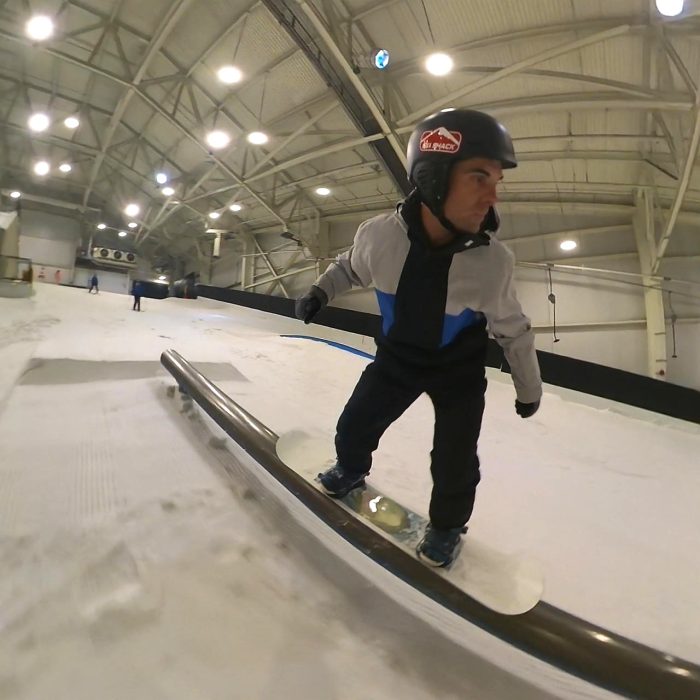
With some effort and precision, you will find a sweet spot to hold presses that’s just outside the insert packs. So while it isn’t the type of jib deck that easily presses, its jibbing highlights are more in the extra pop you get when you’re coming off the features. It’s also got a decently wider waist width to help offer some stability when you’re sliding sideways on it.

I also broke an edge on the sample pre-production version of the Tape Deck I reviewed (more on this here). I came down slightly toe-heavy on a flat bar and an edge dented to the point of breaking into the base. I don’t think that same experience will happen for you in the production-ready version, but I had to call it out.
So if you’re shopping for a dedicated street or jib board, you’ll want to find one with reinforced edges that is a pinch softer. I compare the Tape Deck to Capita’s Ultrafear below. It’s a similar board, but I’d say it’s the better jibber while the Tape Deck is the better jumper.
Buttering
It can butter with speed and practice, but it is not an easy board to butter with. It’s got a 6.5/10 flex with carbon in the tips that will fight you when you try to press the board for a butter.
The flex and carbon are meant to help the board pop higher, so they don’t do many favors with helping you try to butter this deck. If you’re shopping for a board that butters easily, maybe check out the Nidecker Sensor instead of the slightly stiffer Tape Deck.
Riding Switch
It’s a true twin, so it feels exactly the same regardless of which end you have in front. There were a few times I rode away from a feature switch and just kept going into the next one without thinking about it.
The Actual Feel of the Flex
Nidecker rates the Tape Deck with a Mid-Stiff 6 out of 10 flex rating. It feels slightly stiffer to me, so I landed on 6.5 out of 10.
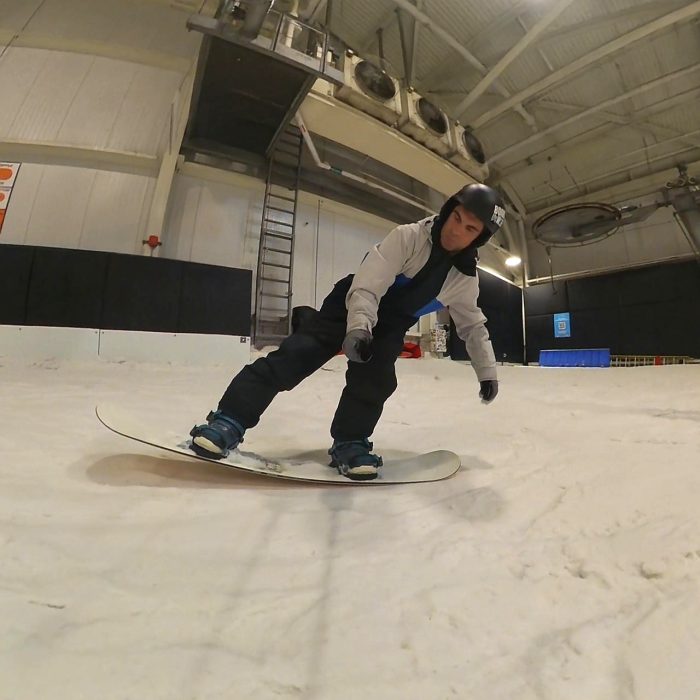
For presses, there is a sweet spot that helps you lock in, but due to the carbon in its tips, it wants to fight you to rebound when you try to flex it. That’s a large factor for why I felt the need to rate it slightly higher than a medium flex score.
Weight of the Deck
Weight-wise it feels pretty average to me. I weighed it at 6.3lbs for just the 153cm deck, and 10.3lbs with the NEO Bindings mounted.
A Note on Durability While Jibbing: I Broke an Edge Jibbing at Big Snow
I have to be honest and report back about some edge damage I ran into. It’s the first time anything like this ever happened, so I am treating it as a quirk, and if you run into anything odd with your board, remember that Nidecker has its 2+1 warranty, and they’ll make the quirks right for you.
Here’s what happened.
I rode the Tape Deck indoors at Big Snow in East Rutherford, New Jersey. One of the jib features there is a square flat bar, meaning it’s a flat bar with 90-degree corners rather than a rounded rail. I went to do a tail slide, and instead of landing flush on my base, I came down a little toe edge-heavy at first.

I rode the trick out fine, but I heard a loud ping, and after my run, I saw I’d dented and broken the toe-side edge right where that first impact hit.
The board looks repairable. The core, base, and topsheet look fine. I should be able to pull the edge out, bend it back with a heat gun, and epoxy everything back together, and be back off to the races. But an edge breaking like that isn’t something I’ve run into before, so I wanted to make you aware of it.
I reached out to Nidecker for context on whether it might be unique to my deck. Their team explained that I was given an early sample to demo, and it’s from a run where the production-line and quality control processes weren’t held to the same standards as the production-ready boards that get sold to the public. That means small defects and bonding quirks can occasionally slip through, and it sounds like that’s what happened with mine. They also noted that their team riders, like Sam Anderson and Jed Sky, have put the final production version of the Tape Deck through heavy street jibbing missions without running into this same issue. So most likely, it is just a quirk and not the experience you’ll run into.
Overall, I still am impressed with how well the Tape Deck rides. I would just be careful if you get a little too toe-heavy with your jibs (which you should never be, because who wants to catch an edge on a rail anyway?).
Who Is the Nidecker Tape Deck Good For?
The Nidecker Tape Deck is outstanding for the intermediate all-mountain freestyle rider looking to carve all over the resort while also leveling up on their jump and side hit progression.

So Who Is the Tape Deck Not For?
The beginner who is just learning to connect turns. For anyone not used to riding camber, this deck can feel catchy, and there are other boards that will help you through your learning curve of connecting your first turns.
The aggressive carver who knows one speed, and that’s as fast as humanly possible. While the Tape Deck is decently responsive and locks into its turns, it is meant for casual resort and park riders. An extremely aggressive rider will want something directional and stiffer that offers even more response.
The park rider looking for a dedicated street or jib board. This board is going to be a pinch too stiff, and its edges don’t have the reinforced tech that a dedicated jib board has. (This board’s park highlights are more for helping you get in the air and to soften your landings.)
The frequent powder rider. While the nose and tail are angled upward to help this deck a little bit in light pow, it doesn’t have a set back stance or any other feature to help it float.
What Are the Pros of the Nidecker Tape Deck?
You Get A Lot of Value for the Price
At $529.95, the Tape Deck comes in at $65 under the average board I’ve reviewed for 2027. That’s before you get into how damp it feels and how well the base holds its glide, both of which had me feeling it cost more than it does. It’s also $20 less than similar boards like the Capita Ultrafear.
Outstanding for Jumping
This deck has an extra 5% boost of pop to offer. This comes from its traditional camber and the Pop Carbon tech found in its nose and tail. The pop is also easy to time, so you can step up to bigger features without the board getting away from you.
A Smooth, Locked-In Carving Experience
Carving is where this board shone for me. Turns roll from toe edge to heel edge without any effort, and it’s great at linking tight to medium s-turns. It felt powerful without feeling like it was too much, which is a hard balance for a freestyle twin to have.
A Quick Base You Won’t Have to Wax Often
The N-7000 hybrid base held its glide through slow, dirty indoor snow with nothing more than a quick wax before I rode. It felt faster than an extruded base and held its wax better than one too. That means less time tuning and more laps.
Rides Like a Higher End Board
Between the Absorbnid topsheet and the Pop Carbon placement, this board kills vibration better than its price point suggests. I originally gave all the credit to my Union NEO bindings. A good chunk of it is the board.
Classic Camber Feel in an Easy to Ride Package
This is real traditional camber, not a hybrid that borrows the name. The pill shape and the generous camber underfoot read as a straight throwback. What’s different from the boards I came up on is the steep kick in the nose and tail, and that’s what keeps it from punishing you the way those decks did.
What Are the Cons of the Nidecker Tape Deck?
Will Feel Too Stiff for Some
At 6.5 out of 10, it’s slightly stiffer than medium, so pressing takes some getting used to and the board wants to fight you a bit. If buttering is your main thing, there are softer twins out there.
Edge Durability for Jibbing
I broke my toeside edge on a pre-production version of this snowboard during this review process. Nidecker reps let me know there are stricter quality control processes in place for the production versions of this snowboard, and assured me that it is unlikely to happen for anyone reading this. I am sure the Tape Deck will be fine to get your first box and rail tricks dialed. Either way, this board is a better carver and jumper than a jib board (it isn’t the softest anyway).
Nidecker Tape Deck vs Capita Ultrafear
A similar board to the Nidecker Tape Deck is the newly reshaped Capita Ultrafear.
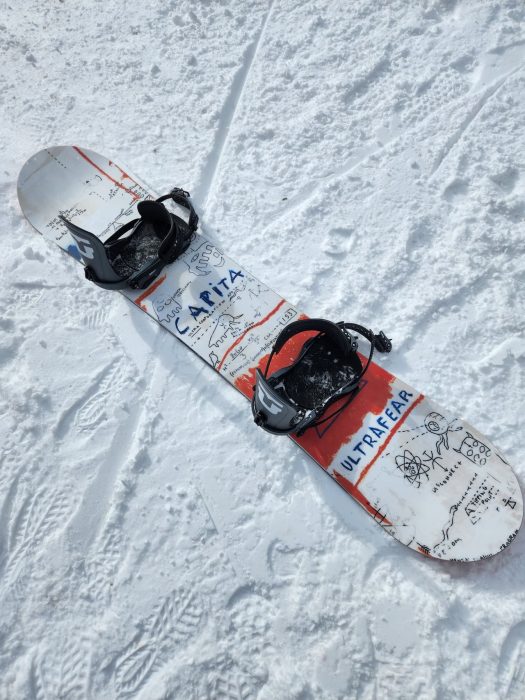
Both of these boards are true twin all-mountain freestyle decks. Both have that rounded-off nose and tail, and both are aimed at the rider who wants to jump and jib and still be able to ride the whole mountain. They cost within twenty dollars of each other.
The Tape Deck is traditional camber, tip to tail, at a 6.5/10 flex. The Ultrafear runs Capita’s Resort V1 with a Flat Kick, which is a rocker, camber, rocker profile, at a slightly softer 6/10 flex.
- The main difference is that the Tape Deck offers more benefits to the jumper while the Ultrafear caters more to the jibber.
- The Tape Deck is the slightly stiffer, fully cambered, more powerful of the two. The Ultrafear has rocker at both ends and is the softer, looser one.
Spec |
Nidecker Tape Deck 2027 |
Capita Ultrafear 2027 |
|---|---|---|
|
Price |
$529.95 |
$549.95 |
|
Shape |
True Twin |
True Twin |
|
Profile |
Traditional camber, steep kicked nose and tail |
Resort V1 + Flat Kick (rocker nose / camber / rocker tail) |
|
Flex (brand) |
Medium-Stiff 6 / 10 |
Medium 5.5 / 10 |
|
My Flex |
6.5 / 10 |
6/10 |
|
Sidecut |
Radial |
Radial |
|
Core |
Light Core (paulownia, poplar, beech stringers) |
P2 Superlight (paulownia, poplar) |
|
Laminates |
Biax Plus + Pop Carbon |
Hybrid Carbon Holysheet Bi/Bi + Magic Bean Resin |
|
Damping Tech |
Absorbnid topsheet |
1.5mm Full Cork Edge Dampening |
|
EdgEdge Material Tech |
Standard High-Grade European Steel |
360 Degree HRC48 Steel Edges |
|
Base |
Sintruded – N-7000 Hybrid |
Sintruded – Superdrive ADV |
|
Sizes |
147, 150, 153, 156, 156W, 159, 159W |
149, 151, 153, 153W, 155, 155W, 157, 157W |
|
Ability Level (evo) |
Intermediate to Advanced |
Intermediate to Advanced |
|
Warranty |
3 Years |
2 Years |
The damping tech is the difference worth covering.
Both boards are aiming for the same dampening goal from different parts of the build and the difference caters them to different types of freestyle riders (the jumper for the Tape Deck vs the jibber for the Ultrafear).
Nidecker adds its dampening from the top down with its Absorbnid topsheet.
Capita adds dampening from the edges inward, with a 1.5mm layer of cork sitting between the steel edge and the ABS sidewall. Both technologies work well, and both are a large factor for why these boards feel more expensive than they actually are.
Choose the Nidecker Tape Deck if
- Jumping is what you care about most.
- The Tape Deck’s full camber and the Pop Carbon tech in the nose and tail give you an extra boost of pop off the lip of jumps and side hits over the Ultrafear.
- The Tape Deck’s full camber and the Pop Carbon tech in the nose and tail give you an extra boost of pop off the lip of jumps and side hits over the Ultrafear.
- You carve as much as you ride park and want something that holds an edge on hardpack.
- You came up on ’90s camber and want that feel back. The Steep Kick tips take some of the catchiness out of it without taking any of the power or response out of the profile.
- You want the longer warranty, which is 3 years against Capita’s 2year warranty.
- You need a 159 or a 159W, which the Ultrafear does not offer.
Choose the Capita Ultrafear if
- Jibbing is what you care about most, and rails, boxes, and street missions are your priority.
- The rocker in the nose and tail is more forgiving when you’re not perfectly flat on features, and CAPiTA designed the 360 Degree HRC48 Steel Edges to resist denting when you smash the edges of your board against an iron rail or support leg.
- The Ultrafear also runs a 1.5mm layer of cork between the steel edge and the ABS sidewall to help protect the board from edge impacts further. The Tape Deck can jib well, too. It doesn’t add in any extra durability features specifically to its edges.
- The rocker in the nose and tail is more forgiving when you’re not perfectly flat on features, and CAPiTA designed the 360 Degree HRC48 Steel Edges to resist denting when you smash the edges of your board against an iron rail or support leg.
- You want a slightly softer board. At 6/10, it presses and butters with a little less resistance.
- You’re still working up to advanced and want something with a more forgiving profile.
- You want more sizing in the 149 to 157 range, including three wide options.
Read my full Capita Ultrafear review for the complete breakdown.
Sizes Available and What Size I Rode
The Tape Deck comes in 147, 150, 153, 156, 156W, 159, and 159W cm. I rode the 153cm and weigh 142lbs with a men’s size 9 boot, which put me right in the middle of Nidecker’s recommended range for that size. Here’s the full chart from Nidecker’s 2027 catalog.
|
Size |
Rider Weight |
Binding Size |
Waist Width |
Sidecut |
Setback |
|---|---|---|---|---|---|
|
147 |
100 to 145 lbs |
S-M |
247mm |
7.2m |
0mm |
|
150 |
110 to 165 lbs |
S-M |
250mm |
7.3m |
0mm |
|
153 |
120 to 175 lbs |
M-L |
253mm |
7.4m |
0mm |
|
156 |
145 to 200 lbs |
M-L |
257mm |
7.5m |
0mm |
|
156W |
145 to 200 lbs |
M-L |
266mm |
7.5m |
0mm |
|
159 |
165+ lbs |
L-XL |
260mm |
7.6m |
0mm |
|
159W |
165+ lbs |
L-XL |
270mm |
7.7m |
0mm |
One thing Nidecker calls out in the catalog is that the Tape Deck runs a wider waist than you might expect, which they say makes it more stable with less overhang. Worth knowing if you’re between sizes or riding a bigger boot.
I usually ride a 153 or 154cm board. The Tape Deck’s 153cm felt right for me without sizing up or down.
Nidecker Tape Deck Specs
|
Model Year |
2027 |
|
MSRP |
$529.95 |
|
My Flex Rating |
6.5 / 10 (slightly stiffer than medium) |
|
Nidecker Flex Rating |
Mid-Stiff 6 / 10 |
|
Shape |
True Twin |
|
Camber Profile |
Traditional camber, tip to tail, steep kicked nose and tail |
|
Setback |
0mm (all sizes) |
|
Sidecut |
Continuous radial, 7.2m to 7.7m depending on size (7.4m on the 153) |
|
Construction |
Premium Sandwich (carbon and Kevlar) |
|
Core |
Light Core (paulownia, poplar, beech stringers) |
|
Laminates |
Biax Plus fiberglass + Pop Carbon |
|
Base |
N-7000 Hybrid (extruded / sintered blend) |
|
Topsheet |
Absorbnid (vibration damping), matte finish |
|
Insert Pattern |
2×4, 6 inserts at 2cm intervals |
|
Terrain |
Freestyle / All-Mountain |
|
Ability Level |
Intermediate to Advanced |
|
Sizes Available |
147, 150, 153, 156, 156W, 159, 159W |
|
Warranty |
3 Years (Nidecker’s 2+1) |
About the Graphics
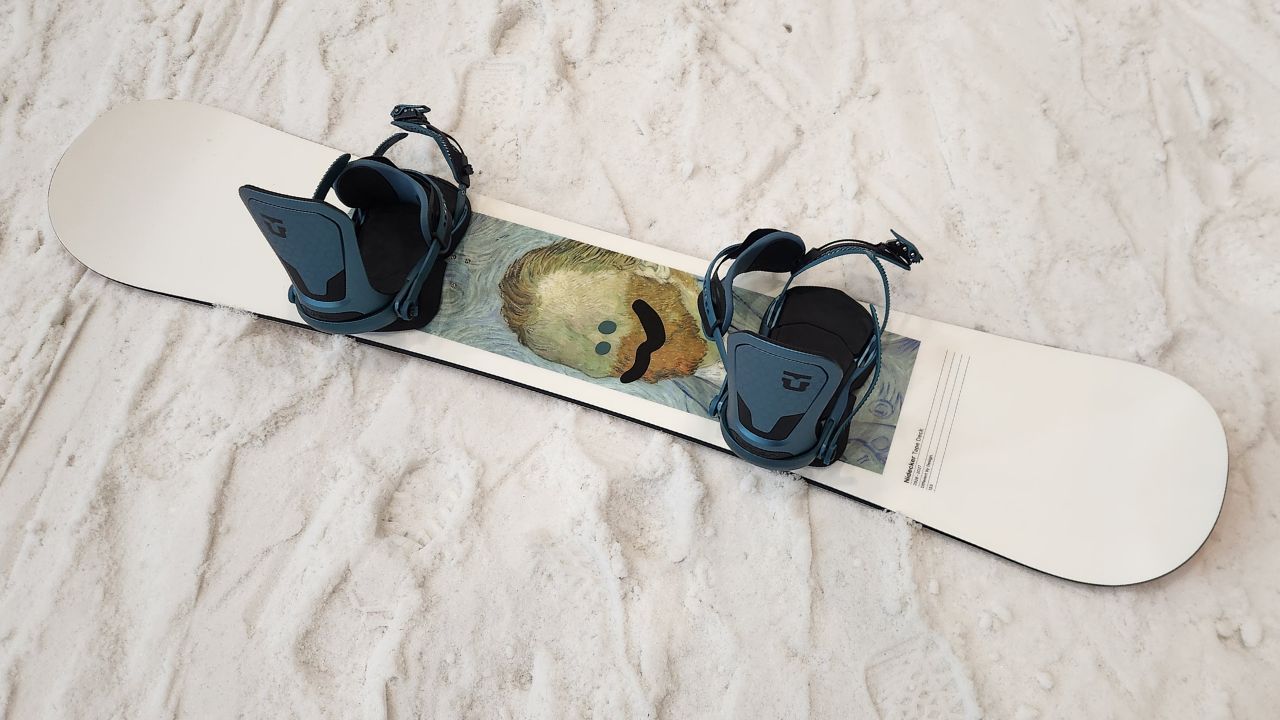
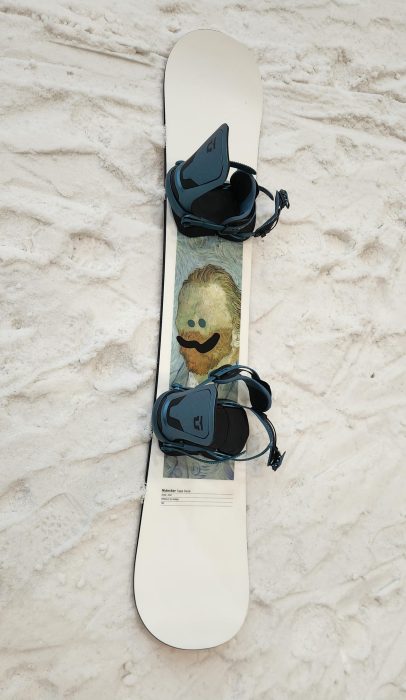
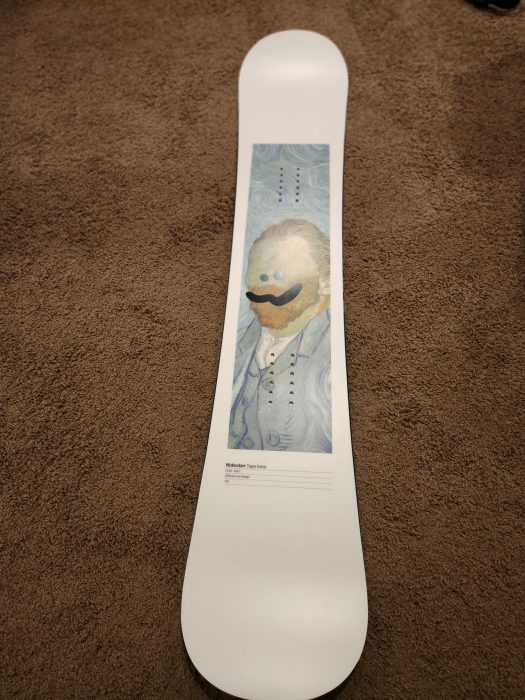
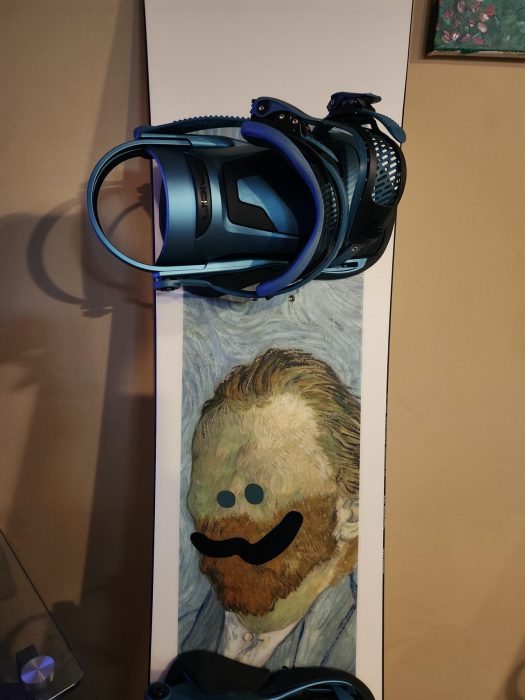
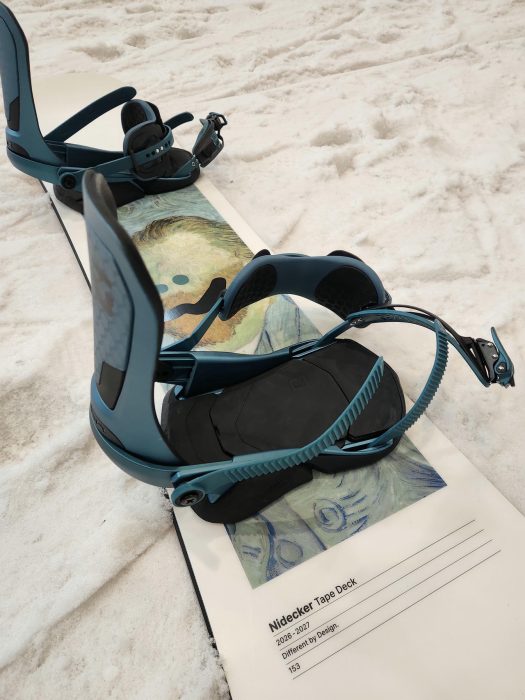
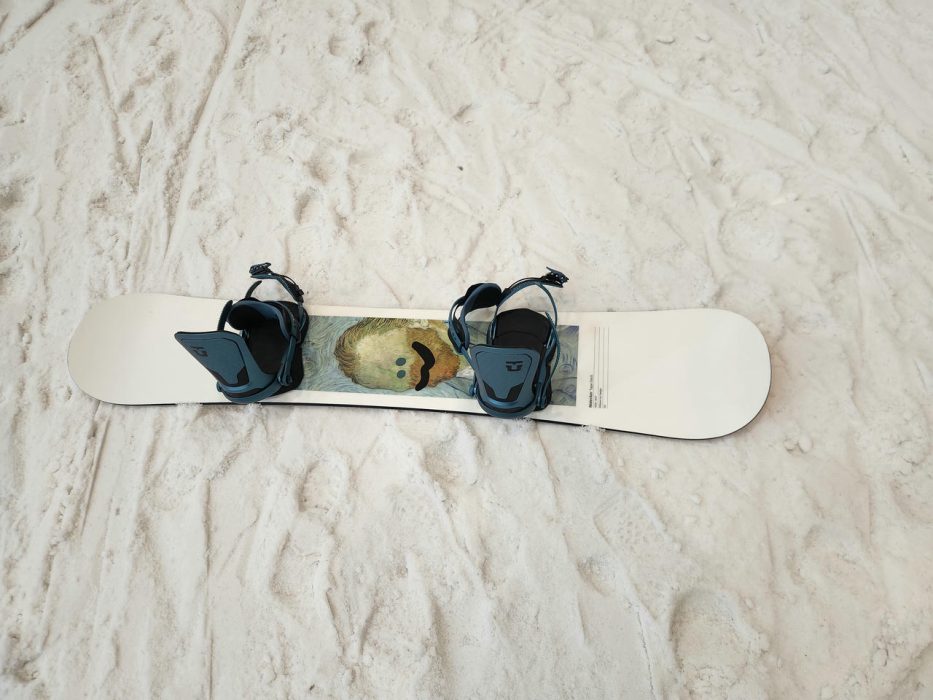
With the Tape Deck, every size gets a different graphic, and they’re all famous paintings with Nidecker’s own take dropped on top. The 147 is Vermeer’s Girl with a Pearl Earring, the 150 is Klimt, the 153 I rode is the Van Gogh self-portrait, the 156 and 156W are the Mona Lisa, and the 159 and 159W are Munch’s The Scream. Each one has the same grin painted over the face.
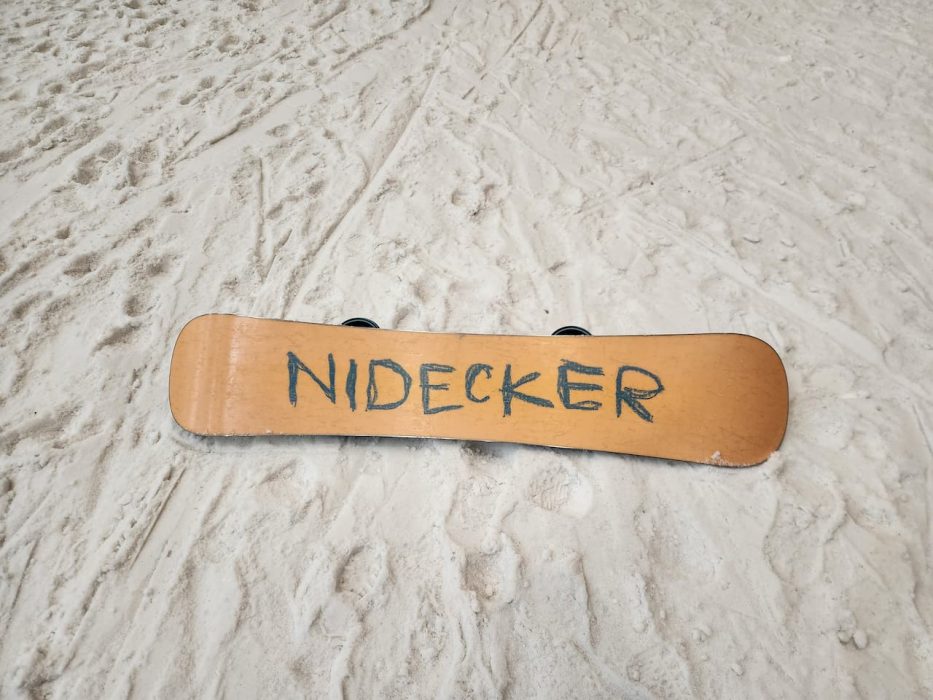
I was stoked my size got the Van Gogh graphic with the bright organgeish yellow base. The topsheet looks awesome with the teal NEO bindings I paired it with and the bright colored looks so sick contrasting against the snow.
What Is the Shape and Camber Profile of the Nidecker Tape Deck?
The Tape Deck is a true twin on traditional camber with no setback (0mm you stand perfectly centered).
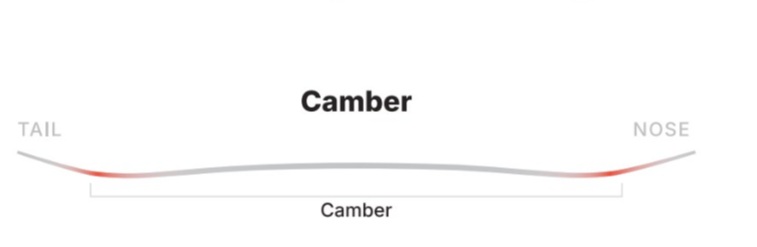
I measured the camber’s arc on my 153cm to show you what traditional camber actually looks like in inches on this board. Here’s what I found on my men’s 153 cm, which comes out to about 60.24 inches tip to tail.
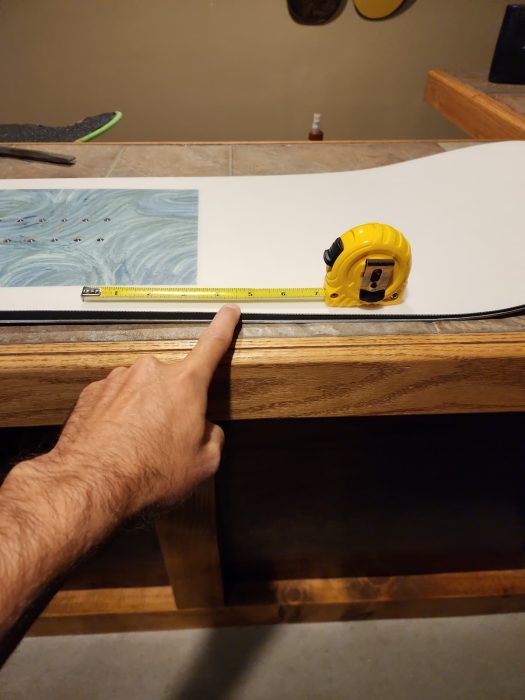
- At the camber’s highest point between your feet, the arc sits a little less than 1/4 inch off the ground when the board is resting flat on the snow. I’d say that’s a generous amount of camber for a freestyle deck.
- The camber arc runs out to about 7 inches past the last set of holes in the insert packs.
- From there you get about 4 inches of flat before the nose or tail starts to arc upward.
- Then it’s roughly 7.25 inches of upward angle making up the nose or tail.
That last stretch is what Nidecker is talking about when the catalog calls out a “Steep Kick” that makes the board ride and land easier than traditional camber usually does. The angle is more exaggerated than the tips of the camber decks I grew up on in the ’90s, and that’s what makes the board feel more forgiving than a traditional camber. All in all, you still get all the power and pop of real camber underfoot. You just don’t get the same level of catchiness for being slightly off axis on a landing.
The sidecut is a continuous radial, and on my 153 it’s a 7.4m radius. That tracks with how smooth and predictable it felt on edge.
What Are the Main Tech Features in the Nidecker Tape Deck?
When you’re riding the Tape Deck, you’ll notice two things over any plain freestyle deck. It’s got an extra boost of pop, and it feels damper than most all-mountain freestyle decks in the $500 to $700 range. Looking at Nidecker’s build sheet, both line up with how it’s put together. The Pop Carbon in the nose and tail is the carbon I was feeling, and the Absorbnid topsheet is why I have to give the board credit for dampness I originally chalked up to my Union NEO bindings.
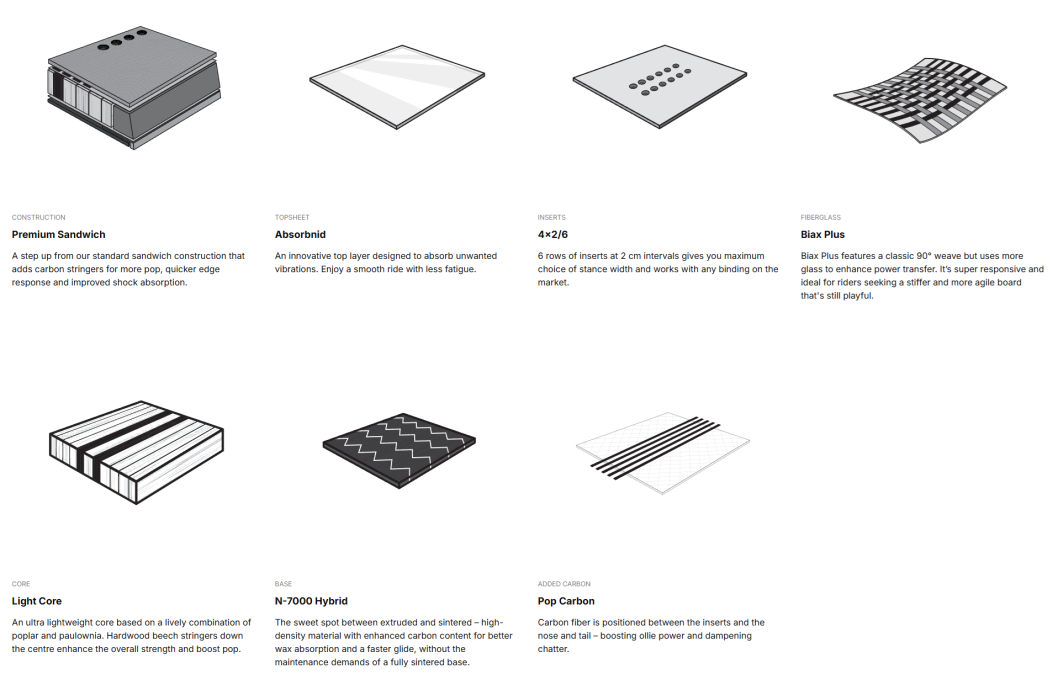
You can learn more about the specs on the Tape Deck’s product page .
Review Wrap-Up: So Is the Nidecker Tape Deck Worth It?
Yes, but for the right rider.
If you are an intermediate rider who wants one deck that can cruise all over the resort and you love to hit jumps, you’ll love the Nidecker Tape Deck.
This deck has a smooth feeling carve that will work all over your favorite resort, it keeps you locks into your turns, it’s got an extra boost of pop that just wants to be in the air, and at $529.95 it offers an excellent value for its price.
Where to Buy the Nidecker Tape Deck
This is an affiliate link pointing to Nidecker’s website. It won’t cost you anything additional, and it supports the site. When you use it, Nidecker shares a small commission from the sale that goes towards more gear to review. (And thanks for supporting the site.)
About the Reviewer
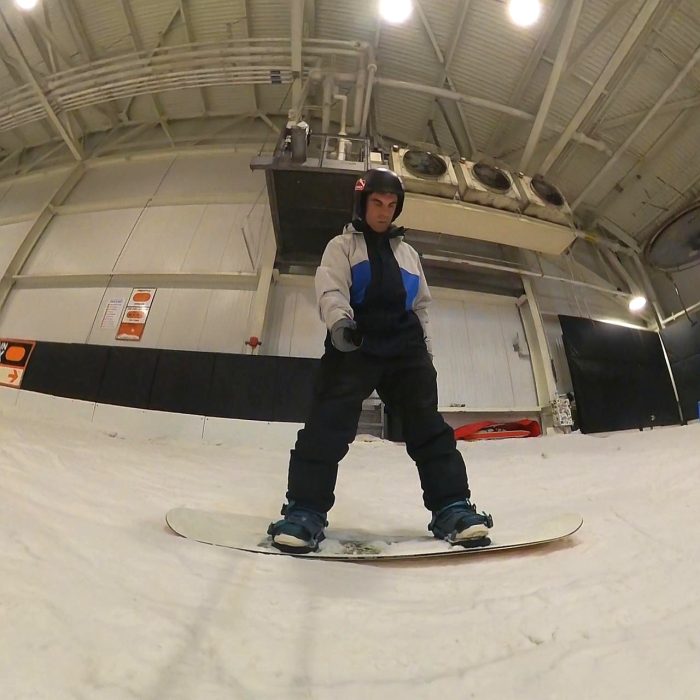
Rider Name: Steve Weber
Board Reviewed: 2027 Nidecker Tape Deck 153cm
Conditions / Where I Rode This: Indoor groomers, park, and ice at Big Snow in East Rutherford, NJ in August of 2026
Bindings Used: Union NEO Bindings
Boots Used: ThirtyTwo STW Boa
Image Gallery of the Nidecker Tape Deck Review